2011 Workshop Committee
Co-Chairs
- Eric Piquette
Teledyne Imaging Sensors - Sivalingam Sivananthan
University of Illinois at Chicago
Proceedings Co-editors
- Sivalingam Sivananthan
University of Illinois at Chicago - Nibir K. Dhar
DARPA *Also website curator
Program Committee
- Tony Almeida
U.S. Army RDECOM CERDEC (NVESD) - Jose M. Arias
Rand Corp./ U.S. Army RDECOM CERDEC (NVESD) - Iswara Bhat
Rensselaer Polytechnic Institute - Arnold Burger
Fisk University - Joseph Burns
Air Force Research Laboratory - William Clark
US Army Research Office
- Roger DeWames
The Corbin Co./U.S. Army RDECOM CERDEC (NVESD) - Chad Fulk
BAE Systems - Tim Gessert
National Renewable Energy Laboratory - Craig Hoffman
Naval Research laboratory - Ralph James
Brookhaven National Laboratory - Scott Johnson
Raytheon Vision Systems - Thomas Myers
Texas State University - San Marcos - Joe Pellegrino
U.S. Army RDECOM CERDEC (NVESD) - Herbert Pollehn
The Corbin Co./U.S. Army RDECOM CERDEC (NVESD) - Marion Reine
Consultant, Infrared Detectors - Herbert Schaake
DRS-RSTA, Inc. - Honnavalli Vydyanath
Avyd Devices, Inc. - Priyalal Wijewarnasuriya
U.S. Army Research Laboratory - Enrico Bellotti
Boston University
Palisades Convention Management
The 2010 II-VI Workshop
Attn: Julie Amodeo
411 Lafayette Street, Suite 201
New York, NY 10003
212-460-8090 ext. 211, fax 212-460-5460
e-mail: jamodeo@pcm411.com
Yesim Anter
Project Coordinator
Department of Physics (M/C 273)
Microphysics Laboratory
845 W. Taylor Str. Room 2360 SES
Chicago, IL 60607
Tel: 312-413-1974
Fax: 312-996-9016
2011 II-VI Workshop
Introduction
Purpose
The purpose of this Workshop is to bring together the
industrial, governmental, and academic communities
that work with II-VI materials. These II-VI materials are
critical in a wide range of detector technologies operating
in the infrared, ultraviolet, x-ray, and gamma-ray
regions of the spectrum. They include HgCdTe, ZnSe,
ZnO, and CdTe, as well as other II-VI semiconductors
and alloys. Spectrometers, imagers, and other sophisticated
systems exploiting various properties of these
materials are finding applications in many fields, including
national security, homeland security, medicine,
industrial process monitoring, basic science, and more.
The Workshop aims at advancing the understanding of
the basic physics and chemistry of these materials, and
thereby contributes to the continual improvement of
these system capabilities.
The 2011 Workshop is the 30th in a series that began in 1981.
Areas of Interest
Areas covered include a broad range of disciplines and materials properties. Included are materials growth and characterization, materials engineering, intrinsic and extrinsic defects and dopants, surface chemistry, fabrication processes, electrical properties and modeling, charge transport, noise sources, optical properties, photorefraction, electro-optical and magneto-optical properties, as well as the interaction among all these.
Workshop Format
The Workshop program will consist of about 60 oral presentations. Invited and contributed papers with a common theme will be grouped for presentation.
To provide ample time for discussion, there are scheduled morning and afternoon breaks. Lunch will be provided, affording additional discussion time. To further promote informal discussion and interaction, the first day will conclude with a wine and cheese reception accompanied by tabletop displays from commercial vendors displaying products and services of interest to the Workshop community.
Authors of accepted papers are encouraged to submit full-length manuscripts, which will be peer reviewed and published as part of the Workshop proceedings in a Special Issue of the Journal of Electronic Materials.
Student participation is strongly encouraged. An award recognizing the best student paper will be presented at the conclusion of the Workshop. Funding exists to support travel to the Workshop. Some student financial assistance is available for conference attendees.
2011 U.S. Workshop Synopsis

The U.S. Workshop on the Physics and Chemistry of II-VI Materials was held on October 4-6 in Chicago, Illinois at the Embassy Suites Chicago Downtown-Lakefront Hotel. It was co-chaired by Dr. Eric Piquette of Teledyne Imaging Sensors, Camarillo, California, and Professor Sivalingam Sivananthan of the Department of Physics, University of Illinois at Chicago.
This is the 30th workshop in this series, which began in 1981. International in scope, the annual workshop brings together university, government and industrial participants in an interactive three-day setting to address fundamental issues in the science and technology of II-VI materials and devices. This year’s workshop had 174 attendees: 63 from U.S. industry, 31 from the U.S. government agencies, 12 faculty members from U.S. universities, 31 students from U.S. universities, plus a total of 37 attendees from foreign countries. There were 98 abstracts submitted, 96 of which were accepted. 22 of the accepted abstracts were included as poster presentations, which was a first in the workshop history. Among these poster presentations, 6 of them were showcased by students. A total of 65 papers were actually presented orally, 11 of which were 30-minute invited papers and 18 were student papers.
This year's workshop featured sessions on the following topics:
- HgCdTe device physics, performance and modeling
- Dopants and defects in HgCdTe
- II-VI solar cells
- II-VI gamma and X-Ray detectors
- Alternative (non-native) substrates for vapor phase growth of HgCdTe and other II-VI materials
- Wide-gap II-VI nanostructures and devices
- Type-II strained layer superlattices
- Processing of HgCdTe materials
- Optical and electrical characterization of HgCdTe materials
- Growth and preparation of CdZnTe substrates for growth of epitaxial HgCdTe
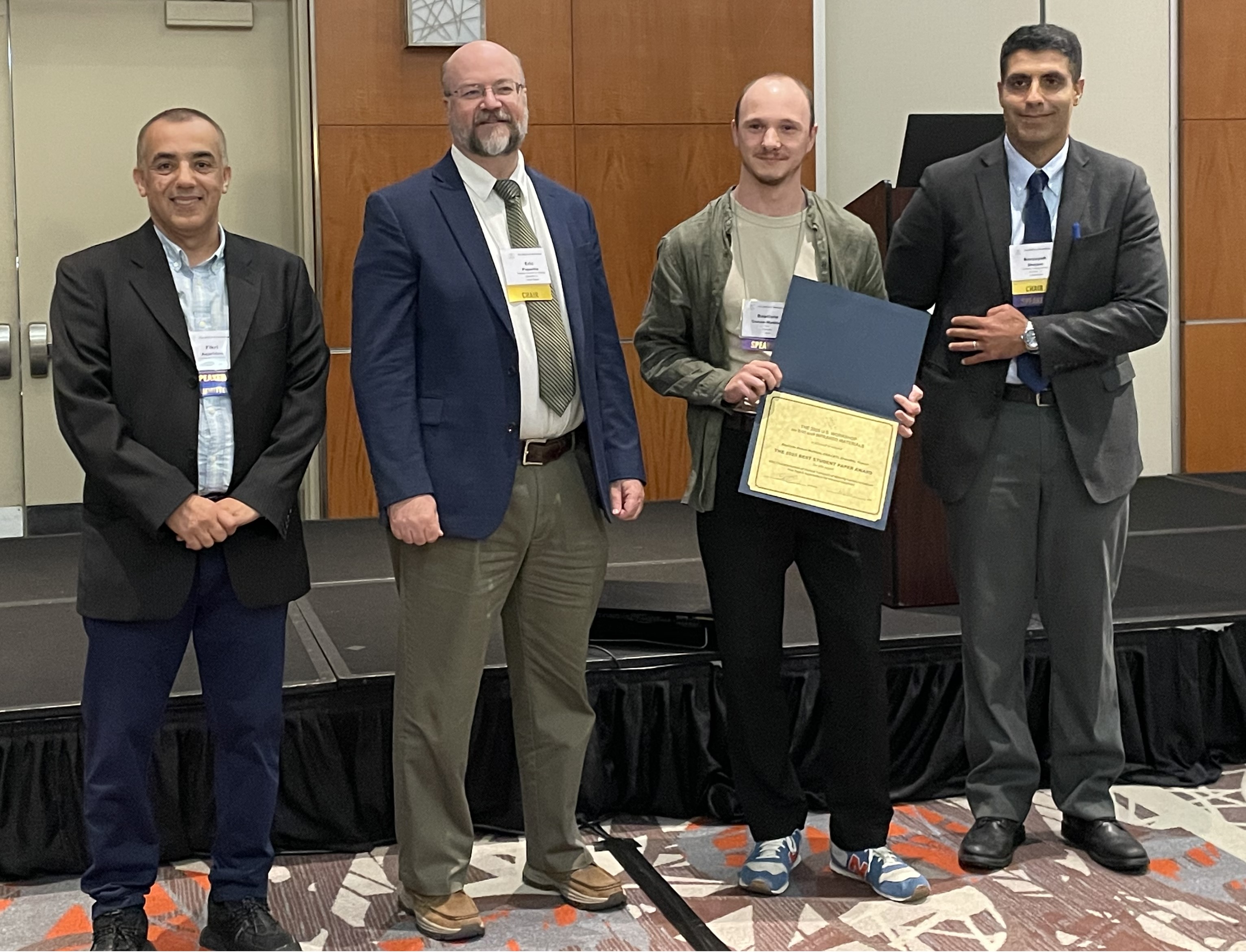
The Best Student Paper award for this year's workshop was presented to Ms. Anne M. Itsuno, a Ph.D. candidate in the Department of Electrical Engineering and Computer Science, University of Michigan, Ann Arbor, Michigan, for her presentation "MBE Grown Single Element HgCdTe nBn Infrared Detectors." Her thesis advisor is Professor Jamie D. Phillips.
Next year's workshop will be held in Seattle, Washington on November 27-29, 2011.
Spicer-Cassleman Award
The Best Student Paper award for this year's workshop was presented to Ms. Anne M. Itsuno, a Ph.D. candidate in the Department of Electrical Engineering and Computer Science, University of Michigan, Ann Arbor, Michigan, for her presentation "MBE Grown Single Element HgCdTe nBn Infrared Detectors." Her thesis advisor is Professor Jamie D. Phillips.
William E. Spicer - Thomas N. Casselman Award for Best Student Paper
Every year the U.S. Workshop on the Physics and Chemistry of II-VI Materials (a.k.a. the II-VI Workshop) Committee selects one of the student presentations to receive an award for the best student paper. Prior to 2004, this award was called simply the “Best Student Paper Award.” Its goal is to encourage student participation and acknowledge excellence in student paper presentations. The award commemorates William E. Spicer’s and Thomas N. Casselman’s memory and is awarded to the student who, in their opinion, had the best student paper at the Workshop. The recipients are presented with a cash award and a plaque. The plaque will have the student’s name and institution engraved upon it and will be his or hers to keep.
Following the passing of Professor William E. Spicer of Stanford University on June 6, 2004, the II-VI Workshop Committee decided to honor Bill Spicer and recognize his role as a co-founder of this workshop as well as his many contributions to the world of science by renaming the “Best Student Paper Award” as the “William E. Spicer Award.” Bill is best known as one of the inventors of modern night vision devices. He developed photoemission spectroscopy and pioneered image-intensification technology.
After the passing of Thomas N. Casselman on August 30, 2010, the Workshop Committee changed the name of this award to the "William E. Spicer - Thomas N. Casselman Award" to recognize Tom’s role as the other co-founder of this workshop and to honor the contributions of Tom Casselman and Bill Spicer. Tom Casselman was a computational solid state physicist, who made important contributions to the fundamental understanding of the physics and chemistry of HgCdTe materials and devices.
William E. Spicer (1929-2004) and Thomas N. Casselman (1933-2010) cofounded the U.S. Workshop on the Physics and Chemistry of the II-VI Materials in 1981. With the help of their peers from industry, government and academia, the co-founders organized the first workshop in Minneapolis, Minnesota, held on October 28-30, 1981. Since 1981, the U.S. Workshop on the Physics and Chemistry of the II-VI Materials has taken place annually and has attracted both US and foreign attendees from industry, government agencies and academia. The workshop proceedings are rigorously peer-reviewed. The proceedings of the workshops from 1981-1991 have been published in special issues of Journal of Vacuum Science and Technology. The proceedings of the workshops since 1992 are published in special issues of the Journal of Electronic Materials (JEM).
The recipients of this award are now working in various government agencies, industrial laboratories and academic institutions. The list below gives the recipients of this distinguished award from 2004 until present day.
| Year | Recipient | Institution | Advisor |
| 2004 | Chad Fulk | University of Illinois at Chicago | Sivalingam Sivananthan |
| 2005 | Min Yung Lee | Korea Advanced Institution of Science and Technology (KAIST) | Hee Chul Lee |
| 2006 | Lianfeng Fu | University of California at Davis | Nigel Browning |
| 2007 | Gwladys Perrais | CEA -LETI-Minatec\DOPT | Gilbert Vincent |
| 2008 | Sophie Derrelle | ONERA/DOTA/CIO | Jerome Primot |
| 2009 | Michele Moresco | Boston University | Enrico Bellotti |
| 2010 | Stuart Farrell | George Mason University | Rao V. Mulpuri |
| 2011 | Anne M. Itsuno | University of Michigan | Jamie D. Phillips |
References:
- "The William E. Spicer - Thomas N. Casselman Award for Best Student Paper," Marion B. Reine, Journal of Electronic Materials, 2011, Volume 40, Number 8, Pages 1615-1617
- "Foreword and the History of the US Workshop on the Physics and Chemistry of HgCdTe (Now the II-VI Workshop)," S. Sivananthan, N. K. Dhar, Y. Anter and T. N. Casselman, Journal of Electronic Materials, 2010, Volume 39, Number 7, Pages 831-836
- "Spicer Award Foreword," Thomas N. Casselman, Journal of Electronic Materials, 2005, Volume 34, Number 6, Page 682
Participating Agencies
- U.S. Army RDECOM CERDEC Night Vision & Electronic Sensors Directorate
- U.S. Army Research Laboratory
- Army Research Office
- U.S. Army SMDC
- U.S. Navy Electro-Optics Center Penn State University
- Office of Naval Research
- Air Force Research Laboratory
- The Minerals, Metals & Materials Society